
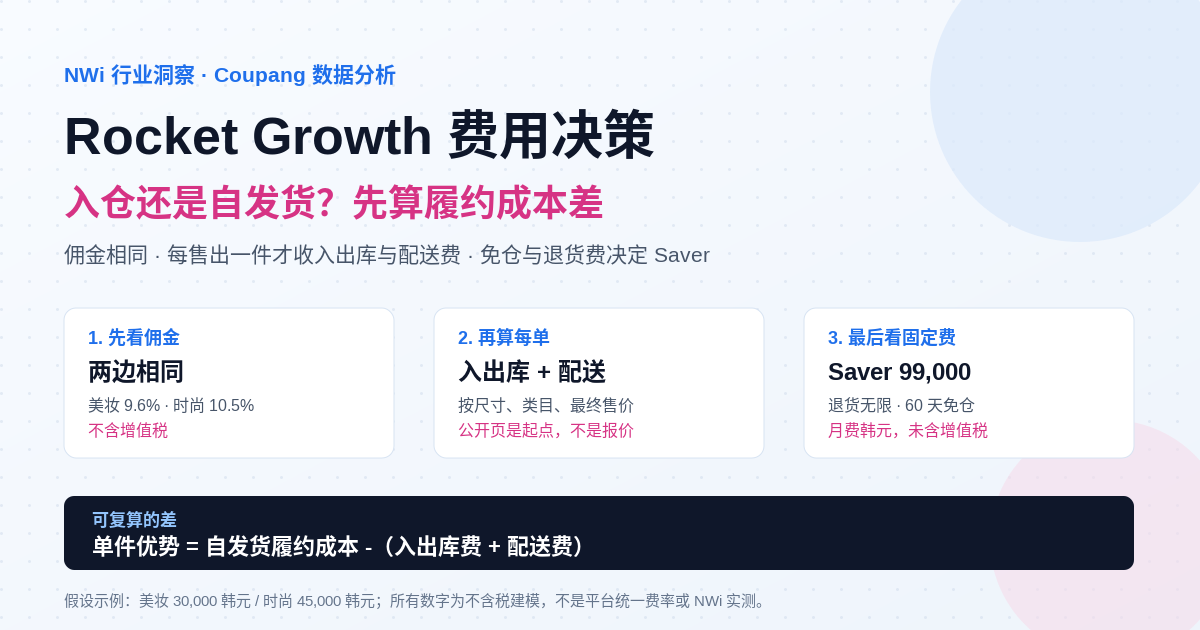
For cross-border sellers with Rocket Growth inbound history or inventory in Coupang Korea, the 25 November 2026 notice turns the service into a one-year contract: existing active sellers must agree by 31 January 2027, or, from 1 February 2027, sales, new listings and new inbound stop, and inventory must be removed at the seller's cost by 28 February. This article first separates who is covered, how product-level review works and what the exit timeline is, then uses two hypothetical sellers to compare signing with exiting and applies the per-unit contribution model to decide which SKUs are worth keeping until 31 December 2027. The sales commission stays the same as seller-fulfilled; what changes is the per-order handling and delivery fee, the 30/45/60-day free-storage windows, the 20 free returns a month and the KRW 99,000 monthly Saver.
1. The decision: sign the annual contract, and which SKUs should stay?
Coupang data analysis here is not a bestseller list; it puts the contract term, product-level review and per-unit contribution on one account. For each SKU, compare staying on Rocket Growth, moving to seller-fulfilled, or leaving before signing, and ask which leaves more money in 2027.
The real question is not whether Rocket Growth is good, but whether this seller should sign a one-year contract by 31 January 2027, and which SKUs should leave before the product-level review rather than be carried to 31 December 2027.
There are three questions: first, whether the seller qualifies as an existing active seller and can sign by 31 January 2027; second, which SKUs may be removed by product-level review, and what removal and self-fulfilment would cost; third, whether the channel benefit of staying on Rocket Growth exceeds the removal, return-resale and badge losses of exit.
A general "sign first and see" answer cannot replace these three calculations. Product-level review, inventory depth, per-unit advantage and removal cost all change the result; the next section separates the event and the mechanism.
2. The event and mechanism: a one-year contract with product-level review
On 25 November 2026, Coupang's seller notice merged the previous Rocket Growth service terms and the fulfilment and logistics terms into one Rocket Growth service contract and moved it to a one-year annual contract. The full notice can be read on Cafe24's seller notice board, where Coupang's official notice is republished; Coupang WING returned HTTP 403 this round and could not be opened directly.
The notice sets this timeline: a seller that created at least one Rocket Growth inbound between 1 January and 24 November 2026, or had inventory in a Coupang warehouse on 24 November 2026, is an existing active seller and can use the 2027 contract until 31 December 2027, but must agree by 31 January 2027. Without that agreement, from 1 February 2027 the seller can no longer sell registered products, register new products or create new inbound; inventory must be removed at the seller's cost by 28 February 2027; stock left after 28 February is automatically returned to the seller from 1 March 2027; and from 1 February 2027 the seller can no longer use the return-resale option, so customer returns are all shipped back at the seller's cost.
The term is one year, but service is not approved once and for all. The notice says Rocket Growth service is decided on product competitiveness and quality, seller operating performance and the logistics service plan, among other factors, and can be reviewed at seller or product level; product registration review is also strengthened, with each product reviewed and confirmed. In other words, signing locks in channel eligibility for 2027, not a pass for every SKU; product-level review is what decides the outcome.
The contract fixes the service term to 31 December 2027, but service can still be reviewed at seller or product level; signing therefore locks in channel eligibility, not a pass for every SKU, and a product-level removal changes both unit contribution and removal cost.
Three seller types are most exposed: first, a small brand among existing active sellers whose inventory is concentrated in a few SKUs, where losing one core SKU changes contribution materially; second, a seller with deep, slow-moving bulky inventory, where removal cost and the loss of the return-resale option are high; third, a low-margin seller that relies on the Rocket badge for conversion, where the channel loss after losing the badge may exceed the fee difference. Conversely, a beauty or small-item seller with diversified SKUs, fast turnover and a clear per-unit advantage has a higher expected gain from signing.
The reproducible signing condition is: expected signing gain = per-unit advantage of approved SKUs x units x remaining months - removal cost of rejected SKUs; sign only when that exceeds the removal, return-resale and channel losses of exit.
Every variable has to come from the seller's own data: the per-unit advantage delta comes from M_RG - M_SF in section 5; units from the last 90 days; remaining months from February to December 2027, or 11 months; removal cost from a Coupang or 3PL quote; channel loss from the conversion and traffic change after losing the Rocket badge, not from an invented percentage. The two scenarios below fix these variables as assumptions and show the arithmetic.
| Date | Notice term | Seller action |
|---|---|---|
| 25 November 2026 | Notice published; the new contract can be reviewed and signed in WING | Confirm eligibility and the SKU list |
| 1 January to 24 November 2026 | At least one Rocket Growth inbound, or inventory on 24 November 2026, makes the seller existing and active | Export the WING inbound record and inventory snapshot |
| 31 January 2027 | Last date for an existing active seller to agree | Sign or decide to exit |
| 1 February 2027 | Unsigned sellers stop sales, new listings and new inbound; the return-resale option closes | Stop new inbound and start removal |
| 28 February 2027 | Last date to remove inventory at the seller's cost | Complete removal and keep proof |
| 1 March 2027 | Inventory not removed is automatically returned to the seller | Reconcile returned stock and costs |
| 31 December 2027 | The 2027 contract term ends | Re-run the renewal model 90 days earlier |
The table turns the annual contract into three actions: confirm eligibility, sign by 31 January, and clear inventory by 28 February. Missing any date turns an option into a cost.
3. Fee mechanism: the commission is unchanged; logistics and free windows change
Coupang's official fee page states that Rocket Growth uses the same sales commission as seller-fulfilled; its January 2025 official deck further states that handling and delivery are charged only on sold products. Inbound is therefore not a fixed upfront fee; it replaces the per-order courier, packaging and outbound labour with a platform handling fee plus a delivery fee based on size, category and final price.
Rocket Growth charges the same sales commission as seller-fulfilled; what changes is the per-order handling and delivery fee charged only on sold units, the free-storage window and the 20 free returns a month, so the contribution difference equals seller-fulfilled logistics cost minus the handling-plus-delivery fee.
The free-storage window is the second variable. The main page gives 30 days per inbound, and 45 days for clothing, shoes and accessories; Saver extends every product to 60 days. Free storage is not free inventory; it is an upper bound for the first inbound, because stock left after the window starts to incur storage fees.
Return fees are the third variable. The main page gives 20 free return pickups, 20 free return restocks and 20 free outbound units a month, as a promotion that can change with notice; Saver makes return pickup and restock unlimited and free. For high-return categories, this can matter more than the per-order logistics gap.
Saver costs KRW 99,000 a month. The official page lists unlimited free return pickup/restock, 60 days of free storage for all products, and free fast settlement up to KRW 5 million a month. It is not a requirement for inbound; it is a fixed-fee option whose value depends on return volume and inventory turnover.
4. Evidence boundary: what the notice and the fee pages do not say
Coupang's main Rocket Growth page and its separate fee page quote different small-item delivery starting points, KRW 1,250 and KRW 1,550; the public pages also do not list a per-SKU storage rate or a per-return fee, so this article treats them as a range and assumptions, not a quote.
The public pages give "from" prices, not a quote for your SKU. The final fee depends on category, size type and final consumer price; the main page says the price is the final consumer price after seller discounts such as instant discounts and downloadable coupons. The only executable number comes from entering the SKU in WING.
The fee basis must also be consistent. The fashion page explicitly says the 10.5% commission is VAT-exclusive, and Coupang's January 2025 official deck says payments are made after fees and the take rate are deducted, VAT excluded; the beauty page only says 9.6% and does not spell out VAT, so this article models everything VAT-exclusive and defers to the WING statement. If your storefront price includes VAT, divide by 1.1 before using the formulas.
The public pages do not give a per-return fee or a per-unit storage rate. This article assumes KRW 2,000 per return and KRW 300 per unit per 30 days, then solves for break-even. If your actual rates differ, the conclusion must change. These are not platform-wide rates or NWi measurements.
There is another boundary: every fee fact comes from Coupang's official pages and official material, a single publisher, and no second independent institution has replicated the schedule. This article does not use competitor data providers to "cross-check" it; instead it states the conflict and gaps in the official pages and handles them with a reproducible model.
Claims such as "1.8x growth" or "Saver sellers grew sales 15%/13%" are platform marketing, not causal experiments; this article does not treat them as evidence that inbound creates incremental sales.
The full 25 November 2026 Coupang notice is readable, but it was read on Cafe24's seller notice board, where Coupang's official notice is republished, and Coupang WING returned HTTP 403; the notice gives no review score, removal rate, removal-cost schedule or fee change, and ETNews only corroborates the contract change, not those missing data.
Fee facts still come from Coupang's official pages and official material, a single publisher; ETNews's independent report only confirms the contract change and product-level review, and provides no fee, review criteria or approval rate. This article does not use competitor data providers to "cross-check" the schedule; it states the conflict and gaps in the official pages and handles them with a reproducible model.
The notice does not mention a fee change, and it gives no review score, removal rate, removal-cost schedule or seller/product counts; the annual contract therefore cannot be written up as a price increase, and no product can be predicted to pass or fail.
5. The math: four accounts, the Saver break-even and the signing threshold
The reproducible formulas are: seller-fulfilled contribution = price - commission - courier/packaging labour - COGS; inbound contribution = price - commission - handling - delivery - COGS; the difference is the fulfilment-cost gap and is independent of price and commission.
Define P as the VAT-exclusive price, r as the commission rate, L as seller-fulfilled courier, packaging and labour, H as handling, D as delivery and C as COGS. Seller-fulfilled contribution M_SF = P - rP - L - C; inbound contribution M_RG = P - rP - H - D - C; the per-unit advantage is delta = L - (H + D). Because rP and C are identical on both sides, they do not change the inbound-versus-seller-fulfilled choice; they only change whether the SKU is worth selling at all.
Saver is a fixed monthly fee, so the monthly break-even is B = (max(R - 20, 0) x F) + S, where R is monthly returns, F is the per-return handling fee and S is storage outside the free window. Saver pays back when B exceeds KRW 99,000; equivalently, the per-return break-even is F* = (99,000 - S) / max(R - 20, 0), and the monthly return break-even is R* = 20 + (99,000 - S) / F.
Size the first inbound from the free-storage window: Q = daily sales x free-storage days. Use 30 days for beauty, 45 for clothing, shoes and accessories, and 60 with Saver. For a new SKU without history, start with a conservative 14-day forecast and replenish within 30 days at the actual sell-through rate. Do not treat 60 days of free storage as a 60-day sales forecast; it is only the storage-fee boundary.
| Account | Charged per order | Fixed or contract term | When to choose |
|---|---|---|---|
| Seller-fulfilled | Commission; courier, packaging, labour | No platform monthly fee | Handling plus delivery is higher than seller-fulfilled logistics, or volume is too small |
| Rocket Growth | Commission; handling; delivery | 30 days free storage (45 for clothing, shoes, accessories); 20 free returns a month | The per-order gap is positive and the first inbound can sell within the free window |
| Rocket Growth annual contract (2027) | Commission; handling; delivery; no fee change announced | One-year contract; product-level review; agree by 31 January 2027 | Review risk is low and the 11-month incremental contribution exceeds the exit cost |
| Rocket Growth + Saver | Same; KRW 99,000 monthly Saver fee | Unlimited return fees; 60 days free storage for all items | Monthly return fees above 20 units plus paid storage exceed KRW 99,000 |
The table splits "inbound" into four accounts: seller-fulfilled, plain Rocket Growth, the 2027 annual contract, and Rocket Growth plus Saver. Calculate the per-unit gap between the first two, then use the contract review risk, monthly returns and storage to decide whether the annual contract and Saver are worth adding.
6. Scenario A: low-return beauty, inbound adds KRW 760,000 a month (hypothetical)
Scenario A: low-return beauty serum, KRW 30,000 net price, 600 units a month (hypothetical)
Assumptions: KRW 30,000 net price (VAT excluded), KRW 8,000 COGS, 9.6% commission, small-item handling KRW 650 plus delivery KRW 1,550; seller-fulfilled courier KRW 3,000 plus packaging and labour KRW 500; 600 units a month, 5% return rate, KRW 2,000 return handling per unit, 20 free returns a month; all 600 units sell within the 30-day free-storage window; advertising, FX and tax excluded.
Result: commission KRW 2,880; inbound contribution KRW 16,920 versus KRW 15,620 for seller-fulfilled, a KRW 1,300 per-unit advantage; 600 units add KRW 780,000 a month; 10 of 30 returns exceed the free allowance, costing KRW 20,000, so the net gain is KRW 760,000; the KRW 99,000 Saver fee would save only that KRW 20,000 and does not pay back.
Decision: use Rocket Growth without Saver; set the first inbound at 30 days times 20 units a day, or 600 units, and start a new SKU with 300 units for a 15-day test; revisit Saver only if monthly returns exceed about 70 units.
The key is not that beauty is a good category; it is that the per-order fulfilment gap for a small item is large. Seller-fulfilled costs KRW 3,500 versus KRW 2,200 inbound, a KRW 1,300 advantage per unit. Only 10 of 30 returns exceed the 20-unit allowance, so KRW 20,000 of return cost cannot consume the KRW 780,000 monthly advantage. Saver would save only KRW 20,000 against a KRW 99,000 fee, so it does not pay back.
Sensitivity: using the main page's KRW 1,250 delivery fee, inbound contribution becomes KRW 17,220, the per-unit advantage KRW 1,600 and the monthly advantage KRW 960,000; the conclusion is still inbound without Saver. The real dividing line is the WING quote, not the public starting price.
7. Scenario B: high-return fashion, Saver turns a near-tie into a positive contribution (hypothetical)
Scenario B: high-return fashion item, KRW 45,000 net price, 300 units a month (hypothetical)
Assumptions: KRW 45,000 net price (VAT excluded), KRW 15,000 COGS, 10.5% commission, medium-item handling KRW 1,250 plus delivery KRW 2,100; seller-fulfilled courier KRW 3,000 plus packaging and labour KRW 800; 300 units a month, 25% return rate, KRW 2,000 return handling per unit, 20 free returns a month; first inbound 600 units sold over 60 days, 45 days free storage, then KRW 300 per unit per 30 days for 15 days; advertising, FX and tax excluded.
Result: commission KRW 4,725; inbound contribution KRW 21,925 versus KRW 21,475 for seller-fulfilled, only KRW 450 per unit; 300 units add KRW 135,000 a month; 55 of 75 returns exceed the free allowance, costing KRW 110,000, and 75 units on average sit in paid storage for 15 days, costing KRW 11,250, so the net gain is KRW 13,750; Saver costs KRW 99,000 and saves KRW 121,250, adding KRW 22,250, so Rocket Growth plus Saver beats seller-fulfilled by KRW 36,000.
Decision: use Rocket Growth plus Saver for this SKU; inbound 600 units for the 60-day free window, but not beyond your cash position and demand forecast; if the per-return cost is below about KRW 1,596 or monthly returns are below about 64, Saver does not pay back and the SKU should return to plain Rocket Growth or seller-fulfilled.
The key is that the per-order advantage is only KRW 450: medium-item handling KRW 1,250 plus delivery KRW 2,100 is KRW 3,350, only KRW 450 below the KRW 3,800 seller-fulfilled cost. Of 75 returns, 55 exceed the allowance, and KRW 110,000 of return cost plus KRW 11,250 of storage cuts the KRW 135,000 monthly advantage to KRW 13,750. Saver spends KRW 99,000 to remove KRW 121,250, lifting the net advantage to KRW 36,000.
Sensitivity: if the per-return cost is KRW 1,500 instead of KRW 2,000, 55 excess returns plus KRW 11,250 of storage total KRW 93,750, below KRW 99,000, so Saver loses KRW 5,250. If monthly returns are only 60 (40 excess), at KRW 2,000 the total is KRW 80,000 plus KRW 11,250, also below KRW 99,000. Recalculate the break-even with your own return and storage rates.
8. Scenario C: a 120-SKU existing seller, sign or exit? (hypothetical)
Scenario C: a 120-SKU existing seller with 30 days of inventory and a 12% contribution margin (hypothetical)
Assumptions: 120 SKUs, 12,000 units a month, average net price KRW 15,000, 12% contribution margin, and a blended Rocket Growth advantage of KRW 800 per unit over seller-fulfilled; 10% of units come from 12 higher-review-risk SKUs with only KRW 200 per unit of advantage; inventory is 30 days, or 12,000 units, and removal costs KRW 1,500 per unit; if a risk SKU is rejected, half of its inventory is assumed to sell through seller-fulfilled and half is removed; the contract term is 11 months from February to December 2027; channel loss, return-resale loss and the review outcome are assumptions.
Result: after signing, the 110 normal SKUs contribute 10,800 x 800 = KRW 8.64 million a month of advantage; the 12 risk SKUs contribute 1,200 x 200 = KRW 240,000 a month if approved; if rejected, that KRW 240,000 disappears and 600 units cost KRW 900,000 to remove. If all risk SKUs are rejected, the 11-month signing gain is 8.64 million x 11 - 900,000 = KRW 94.14 million; exit carries 12,000 x 1,500 = KRW 18 million of removal, KRW 19.8 million from losing half of 600 monthly returns to resale (600 x 50% x 6,000 x 11), and KRW 23.76 million of channel loss (10% x 21.6 million x 11), or KRW 61.56 million in total. Signing is ahead by KRW 32.58 million.
Break the two exit items down: KRW 19.8 million = 600 returns x 50% x KRW 6,000 x 11 months; KRW 23.76 million = KRW 21.6 million monthly contribution x 10% x 11 months. Neither is a platform rate; both are scenario assumptions, and the reader should substitute their own return rate, resale recovery and channel loss.
Decision: sign, but list the 12 risk SKUs separately before signing and calculate their removal cost and seller-fulfilled contribution; if risk SKUs exceed about 33% of units, or removal cost doubles, exit can overtake signing, so remove those SKUs first.
The point is not the number 120; it is that the risk SKUs are only 10% of units but carry the removal cost most easily left out of the signing account. The KRW 8.64 million monthly advantage from normal SKUs covers the KRW 900,000 one-time removal. If the risk share x rises to about one third, the signing advantage is overtaken by removal and channel loss. Let x be the risk share: the signing advantage is about 95.04 - 101.4x million won; setting it equal to the KRW 61.56 million exit cost gives x of about 33%.
Sensitivity: if removal costs KRW 3,000 per unit instead of KRW 1,500, the risk-SKU removal doubles to KRW 1.8 million, the signing gain falls to KRW 93.24 million and still beats exit; if channel loss is 20% instead of 10%, exit cost rises to KRW 85.32 million and signing looks better. Exit overtakes when the risk share approaches one third, or when the normal SKU advantage falls to about KRW 500 per unit.
The review outcome is simplified into a stress test where all risk SKUs are rejected; the actual approval rate is unknown and the notice does not give one. A positive approval rate would raise the signing gain but would not change the order: handle the risk SKUs first.
9. Scenario D: eight slow-moving bulky SKUs that the annual contract cannot rescue (hypothetical)
Scenario D: eight slow-moving bulky SKUs where Rocket Growth costs KRW 4,000 more per unit (hypothetical)
Assumptions: eight SKUs, 200 units a month, KRW 40,000 net price, KRW 20,000 COGS, 10% commission, Rocket Growth handling plus delivery KRW 12,000, seller-fulfilled courier, packaging and labour KRW 8,000; Rocket Growth contribution = 40,000 - 4,000 - 20,000 - 12,000 = KRW 4,000, seller-fulfilled = 40,000 - 4,000 - 20,000 - 8,000 = KRW 8,000, a difference of -KRW 4,000 per unit; 2,000 units in stock, removal KRW 2,500 per unit; 11-month term; advertising, FX and tax excluded.
Result: staying on Rocket Growth gives up 200 x 4,000 x 11 = KRW 8.8 million over 11 months; exiting these eight SKUs to seller-fulfilled costs 2,000 x 2,500 = KRW 5 million in removal and gains KRW 8.8 million, a net KRW 3.8 million gain. If these eight SKUs are the whole business, exiting the contract also loses the Rocket badge and the return-resale option, and that channel loss must be added; on per-unit contribution alone, they should not stay on Rocket Growth for the sake of the annual contract.
Decision: remove these eight SKUs first, or at least stop creating new inbound for them before signing; if the seller also has healthy SKUs, sign for the healthy core and treat these eight as voluntary exits rather than waiting for product-level review.
The counterexample matters because the annual contract is not a reason to keep every SKU. A bulky SKU with a negative advantage loses the fulfilment gap every month; KRW 5 million of removal is recovered by KRW 8.8 million of contribution over 11 months. The real unknown is channel loss: if losing the Rocket badge halves these eight SKUs' sales, the conclusion must be recalculated.
10. Counterexamples and stop conditions: which SKUs should not enter the annual contract
The counterexample is a seller with deep, slow-moving bulky inventory: even after signing, product-level review can remove core SKUs, and removal plus the loss of the return-resale option can cost more than the channel benefit of staying on Rocket Growth.
The counterexample is a large or heavy item: when handling plus delivery exceeds the courier, packaging and labour cost of seller-fulfilled, Rocket Growth costs more per order; a high-return, slow-moving fashion item can also consume a thin per-order advantage.
Put a large item into the formula: assume a large-2 SKU with handling KRW 1,375 and delivery KRW 4,100 on the fee page, or KRW 5,475 total; seller-fulfilled courier, packaging and labour is KRW 3,500, so the per-unit advantage is negative KRW 1,975. Unless inbound can be shown to create incremental sales, this SKU should not give up seller-fulfilled for "inbound".
The low-price counterexample is not a smaller per-unit advantage (that is set only by the fulfilment-cost gap); it is a contribution too thin to absorb fixed fees. If inbound contribution is only KRW 3,000 and you sell 100 units a month, the KRW 99,000 Saver fee needs KRW 99,000 divided by the per-return fee in excess returns or equivalent storage to break even; the smaller the volume, the harder the fixed fee is to spread.
Stop conditions can be fixed in advance: first, exit if inbound net contribution is below seller-fulfilled for two consecutive months; second, recalculate Saver if the actual return rate is 5 percentage points above the assumption; third, reduce the first inbound or move to Saver if paid storage exceeds 20% of inbound contribution; fourth, do not use Rocket Growth if the WING handling-plus-delivery quote is above seller-fulfilled logistics; fifth, if the 2027 contract is not signed by 31 January 2027, stop new inbound immediately and work back from the 28 February removal deadline; sixth, if risk SKUs exceed about 33% of units, remove them before signing.
11. Action list: from the WING contract entry to the 2027 review
First confirm the 2027 contract entry and each SKU's review status in WING, then use the 1 January to 24 November 2026 inbound record and the 24 November 2026 inventory to confirm eligibility, sign by 31 January 2027, and clear rejected inventory by 28 February 2027.
- 1. Check the 2027 contract entry, signature status and each SKU's review/confirmation status in WING; record the date and page.
- 2. Export the Rocket Growth inbound record from 1 January to 24 November 2026 and the 24 November 2026 inventory snapshot to confirm existing-active status.
- 3. Calculate delta = M_RG - M_SF for each SKU; put every SKU with delta at or below zero on the voluntary-exit list instead of keeping it for the annual contract.
- 4. For each risk SKU, get a removal quote, the seller-fulfilled contribution and the return-resale loss; use the signing threshold to decide whether to remove first or sign first.
- 5. Sign by 31 January 2027; if not signed, stop new inbound from 1 February 2027 and work back from the 28 February removal deadline.
- 6. Complete removal of rejected inventory by 28 February 2027 and keep proof; reconcile automatically returned stock after 1 March 2027.
- 7. Re-run the renewal model 90 days before 31 December 2027 with the latest fees, review results and actual removal costs.
For execution, use the Coupang data analysis platform to review category, price band and product structure in Korea, then use NWi CrossborderGo to put brand, store and product data into one research workflow. For selection, profit and replenishment in an operations tool, see NWi Operations; to connect platform reports to a research workflow, see MCP data access; for expert research and review insight, see the Cross-border Agent; for a SKU-specific fee and entry assessment, go to inquiry and demo.
12. Limitations, method and disclosure
Data basis: commission, handling, delivery, free-storage windows and return-fee allowances come from Coupang Marketplace's Rocket Growth main page, fee page, beauty category page, fashion category page and Saver page, accessed on 26 November 2026; the "charged only on sold products" and "VAT excluded" mechanics come from Coupang's January 2025 official deck; commission is calculated on the VAT-exclusive final selling price, and handling and delivery are treated as charged only on sold units, as the official material states; 30-day free storage, 45 days for clothing, shoes and accessories, 60 days with Saver, 20 free returns a month and the KRW 99,000 Saver fee are current promotional or rate terms and may change. The one-year 2027 contract, existing-active definition, product-level review, 31 January 2027 agreement deadline, 1 February service stop, 28 February removal deadline, 1 March automatic return and the closing of the return-resale option come from Coupang's 25 November 2026 seller notice, read in full on Cafe24's seller notice board, where Coupang's official notice is republished, because Coupang WING returned HTTP 403; ETNews's 26 November 2026 report independently corroborates the contract change but provides no fee, review criteria or approval rate. Calculation: seller-fulfilled contribution = price - commission - courier/packaging labour - COGS; inbound contribution = price - commission - handling - delivery - COGS; Saver break-even = monthly return fees above 20 units + storage outside the free window > KRW 99,000; expected signing gain = approved SKU per-unit advantage x units x remaining months - rejected SKU removal cost. All prices, COGS, return rates, return-handling fees, storage rates, SKU counts, inventory days, review outcomes, removal costs and channel losses are labelled assumptions, not Coupang's universal rules or NWi measurements.
This article was prepared with automated research assistance and analysed from the public sources listed at the end; it was not manually reviewed. It does not invent customer data, expert review, sales lift, ranking results or platform endorsement. It is not legal, tax, platform-operations or investment advice.
This article has no WING contract page, review criteria, removal rate, removal-cost schedule or seller inventory data; the SKU counts, inventory days, per-unit advantages, removal costs and channel losses in the scenarios are labelled assumptions, not Coupang rules or NWi measurements.
The unknowns most likely to change the conclusion are the WING contract status, the product-level review criteria and approval rate, the removal quote, the actual return rate and resale recovery, the channel loss after losing the Rocket badge, and the sell-through of the first inbound. If any changes, re-run the same formulas rather than reusing the numbers in this article.
Rates and promotions can also change: 30/45/60-day free storage, 20 free returns a month and the KRW 99,000 Saver fee are the terms shown on the official pages on 26 November 2026, and the pages say changes are announced in advance; check WING and the latest notice before acting. This article is not legal, tax or platform-operations advice.
13. Sources
- 1. Coupang Marketplace, "Coupang Rocket Growth" (primary: same commission, handling/delivery starting points, 30/45-day free storage, 20 free returns a month, Saver 60-day storage): read the original
- 2. Coupang Marketplace, "Rocket Growth fees" (primary: small KRW 650 + 1,550, medium KRW 1,250 + 2,100, the page does not spell out VAT, free storage and return allowances): read the original
- 3. Coupang Marketplace, "Beauty category" (primary: 9.6% beauty commission, small KRW 650 + 1,550, medium KRW 1,250 + 2,100): read the original
- 4. Coupang Marketplace, "Fashion category" (primary: 10.5% fashion commission, VAT-exclusive, medium KRW 1,250 + 2,100, 45-day apparel storage): read the original
- 5. Coupang Marketplace, "Rocket Growth Saver" (primary: KRW 99,000 monthly fee, unlimited return pickup/restock, 60-day storage, fast settlement): read the original
- 6. Coupang Marketplace, "Introduction to Coupang Rocket Growth (2025.01)" (primary: handling and delivery charged only on sold products, payment after fees and take rate, VAT excluded; used only for billing mechanics, not current rates): read the original
- 7. Cafe24 Marketplace, "신규 로켓그로스 서비스 계약 안내" (Coupang notice of 25 November 2026, republished: one-year contract, existing-active definition, 31 January 2027 agreement, 1 February 2027 service stop, 28 February 2027 removal, 1 March 2027 automatic return, return-resale option closed): read the notice
- 8. ETNews, "쿠팡, '로켓그로스' 연간 계약 도입…배송 넘어 셀러 우위 다진다" (independent report: confirms the annual contract, product pre-approval and 2027 service guarantee; does not provide review criteria, approval rate or fees): read the report
14. Original analytical contribution
The contribution is to turn "sign the annual contract or not" from a contract-length question into a comparison of product-level review risk and removal cost, with a reproducible signing threshold: when the removal cost of rejected SKUs exceeds the incremental contribution of keeping the channel, remove those SKUs before signing.
The second contribution is turning the 2027 timeline into an executable countdown: sign by 31 January, service stops on 1 February, inventory is removed by 28 February and automatically returned from 1 March. Those four dates turn "should we sign" into "when do we stop new inbound and when do we move stock".
The third contribution is turning Saver from "should I buy the membership" into a monthly inequality: do return fees above 20 units plus storage outside the free window exceed KRW 99,000? The beauty scenario has only KRW 20,000 and does not buy; the fashion scenario has KRW 121,250 and does; when the per-return cost falls to KRW 1,500, fashion flips back to no Saver.
The fourth contribution is keeping the delivery-fee difference between official pages as a range instead of pretending there is one number. The public page is the starting point; the WING quote is the executable cost. The conservative calculation and sensitivity analysis make that distinction visible in the decision.
The fifth contribution is moving the review unit from seller to SKU: under one annual contract, normal and risk SKUs can differ by tens of millions of won in expected contribution. Removing negative-advantage SKUs before signing is more robust than signing the whole portfolio.