
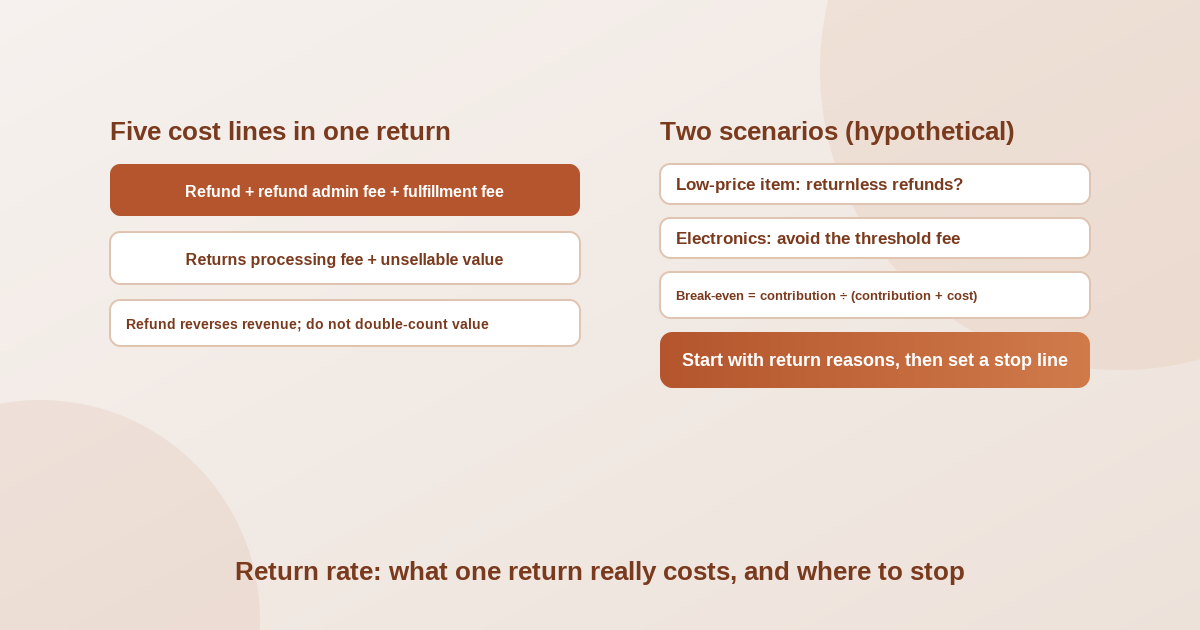
For cross-border sellers on Amazon US, when a SKU's return rate comes in above expectation, the real question is not whether the rate itself is high, but how much this return actually costs, and whether to fix the listing, switch on returnless refunds, or delist to stop the loss. The answer comes in three steps: first align the return rate with your own settlement basis (whether the platform charges a returns processing fee above a category return-rate threshold has to be checked in your Seller Central fee preview, not copied from an outside rate card), then break the loss on one return into five amounts (refund administration fee, fulfillment fee, returns processing fee, unsellable purchase value, and disposal fee), and finally use the break-even return rate to decide whether to fix the listing, enable returnless refunds, or delist. Every fee and scenario figure in this article is an explicitly labeled assumption, not a category rate published by the platform, a platform average or real store data.
1. The decision: when the return rate is high, fix the listing, offer returnless refunds, or delist
For cross-border sellers on Amazon US, when a SKU's return rate comes in above expectation, the real question is not whether the rate itself is high, but how much this return actually costs, and whether to fix the listing, switch on returnless refunds, or delist to stop the loss.
The key to that decision is separating the reasons for returns: selection returns caused by unclear sizing, specification or description can be cut by fixing the listing; a defective product sends you back to the supplier; damage in transit calls for better packaging; and bracketing (buying several of the same item and returning the rest) and fraudulent returns are controlled with policy or returnless refunds. The same return rate implies opposite actions depending on the reason, which is why this article covers return reasons before costing them.
2. Mechanism: the five amounts through which a return erodes profit
A return does not only cost the refund amount: the refund reverses the revenue, but the fulfillment fee, the refund administration fee and a returns processing fee above the category threshold may not be refunded or may be charged separately, and an unsellable unit loses its purchase value plus a disposal fee.
Of these five amounts, the refund is the most visible line, but seller reports often show only the refund while the other items sit scattered across settlement periods as fees, so the true cost of a return is understated. This article does not reproduce any third-party rate card: whether a refund administration fee is charged, whether the fulfillment fee is returned, and whether a returns processing fee is triggered all depend on your marketplace, category and account settings, and the only reliable place to check them is the fee preview and settlement reports in Seller Central. A purely hypothetical arithmetic example shows why the refund alone is not enough: assume a selling price of USD 9.99, commission USD 1.50, fulfillment fee USD 3.86, refund administration fee USD 0.30, returns processing fee USD 1.84 and purchase value USD 1.80; if this return is above the category threshold, the extra cost of one sellable return is 0.30 + 3.86 + 1.84 = USD 6.00, more than twice the USD 2.83 unit contribution.
3. Align the definitions first: return rate, refund and return cost are not the same thing
If these three definitions are not aligned first — how the return rate is calculated, whether refunds are counted again as a cost, and which returns incur the processing fee — every later calculation will be wrong. The table below sets out the metrics and definitions used in this article.
| Metric | Definition | Use in this article |
|---|---|---|
| Return rate | Units returned ÷ units sold in the same period, attributed to the original sales month; can be measured in units or in value | Deciding whether a category return-rate threshold may apply and whether a returns processing fee is triggered |
| Refund | Revenue returned to the buyer per order, already deducted from net sales | Not counted again in the cost of returns, to avoid double-counting the refund and the purchase value |
| Refund administration fee | The portion of the commission the platform keeps on a refund (whether it applies and on what basis must be checked in the settlement report) | One of the fixed loss items on a return, if applicable |
| Returns processing fee | A per-unit fee the platform may charge on the portion above a category return-rate threshold (whether it applies, and the threshold and tiers, must be checked in the fee preview) | Judging whether high returns bring an extra platform fee |
| Extra cost of a return | Refund administration fee + fulfillment fee + returns processing fee + (if unsellable) purchase value + disposal fee | The denominator of the break-even return rate |
The returns processing fee works like this: a platform may set a return-rate threshold by category and charge per unit only on returns above it; thresholds and rates differ by marketplace, category, size and weight, and this article does not reproduce any third-party rate card. Check it this way: open the fee preview or a settlement report in Seller Central, find the fee lines for the SKU's most recent return, confirm whether a refund administration fee, fulfillment fee and returns processing fee appear and at what amount, then plug those real values into the formula below. If your category has no returns processing fee at all, set that line to zero and the conclusion becomes more favorable.
4. Evidence boundary: what these numbers can and cannot tell you
NRF's 15.8% and 19.3% are self-reported estimates from large US retailers (annual revenue above USD 500 million), not measured return rates from Amazon or any cross-border platform, and cannot be taken directly as your category target.
What can be verified word for word is the return rate, sample and survey method in the NRF press release, and the returns policy, returnless refunds, restocking fee, scan-and-refund and seller-fulfilled returns process in Amazon's official blog; what cannot be derived is your own category's real return rate, the returns processing fee threshold and tiers that apply to your account, how the refund administration fee and fulfillment fee are actually handled, and how much of a return is repairable selection behavior. Amazon's fee pages are shown only after signing in to Seller Central, and this article did not obtain a publicly citable official rate table, so it does not present any third-party relayed threshold or amount as a platform fact; every rate in the scenarios is an assumption.
5. Reproducible analysis: return cost and stop-loss line in two scenarios
Both scenarios below are explicitly labeled hypothetical examples, used to demonstrate the method rather than to give conclusions; the thresholds and rates in both scenarios are assumed values, not category data published by the platform. The core formula is break-even return rate = unit contribution ÷ (unit contribution + weighted extra cost per return), where unit contribution = selling price - commission - fulfillment fee - purchase value, and weighted extra cost per return = sellable share × extra cost of a sellable return + unsellable share × extra cost of an unsellable return.
Scenario A: low-price home small item, 10% return rate already above threshold (hypothetical example)
Hypothetical example: the return-rate threshold that applies to this SKU is 8% (an assumed value, not a category rate published by the platform), selling price USD 9.99, commission 15% (USD 1.50), purchase value USD 1.80, FBA fulfillment fee USD 3.86, returns processing fee USD 1.84 per unit on the above-threshold portion, refund administration fee USD 0.30, return rate 10%, unsellable share 40%.
Calculation: because the USD 1.84 fee applies only to returns above the 8% threshold, the average processing fee per return at a 10% return rate is 1.84 × (10% - 8%) ÷ 10% = USD 0.368; extra cost of a sellable return = 0.30 + 3.86 + 0.368 = USD 4.528; extra cost of an unsellable return = 4.528 + 1.80 + 0.50 (assumed disposal fee) = USD 6.828. Unit contribution = 9.99 - 1.50 - 3.86 - 1.80 = USD 2.83; weighted extra cost per return = 0.6 × 4.528 + 0.4 × 6.828 = USD 5.448; break-even return rate = 2.83 ÷ (2.83 + 5.448) = 34.2%.
Result: average processing fee per return USD 0.368, weighted extra cost per return USD 5.448, unit contribution USD 2.83, break-even return rate 34.2%; for every 100 units sold, USD 54.48 of extra return cost eats 21.4% of the contribution retained on kept orders.
Decision: at a 10% return rate, the average processing fee per return is USD 0.368, and adding the unsellable risk of USD 0.92 gives about USD 1.29, below the USD 1.80 purchase value, so a blanket returnless-refund policy for all small items under USD 9.99 is not justified merely because the category is above threshold; for a specific return that is above the threshold and likely unsellable, however, USD 1.84 + USD 0.92 = USD 2.76 is above the purchase value, so returnless refunds can be used selectively, with a price cap to control abuse. Returnless refunds save the returns processing fee, reverse logistics and the unsellable risk, at the extra loss of only the purchase value; for a specific return that is expected to be unsellable, or where return shipping and processing fees together exceed the purchase value, returnless refunds are the better deal. Amazon's official guidance says returnless refunds suit low-price items (where return shipping may exceed the value) and lets sellers configure the rule's scope; the exact limits and eligibility rules are governed by Seller Central settings.
Scenario B: high-price electronics accessory, 11% return rate close to threshold (hypothetical example)
Hypothetical example: the return-rate threshold that applies to this SKU is 11.2% (an assumed value, not a category rate published by the platform), selling price USD 39.99, commission 15% (USD 6.00), purchase value USD 12.00, FBA fulfillment fee USD 5.61, refund administration fee USD 1.20, return rate 11% (below threshold), unsellable share 25%.
Calculation: with the threshold not exceeded no returns processing fee applies, so the extra cost of a sellable return = 1.20 + 5.61 = USD 6.81; extra cost of an unsellable return = 6.81 + 12.00 + 2.27 (assumed disposal fee) = USD 21.08; weighted extra cost per return = 0.75 × 6.81 + 0.25 × 21.08 = USD 10.38. Unit contribution = 39.99 - 6.00 - 5.61 - 12.00 = USD 16.38; break-even return rate = 16.38 ÷ (16.38 + 10.38) = 61.2%.
Result: with the threshold not exceeded, weighted extra cost per return USD 10.38, unit contribution USD 16.38, break-even return rate 61.2%; if the return rate rises to 13%, the above-threshold portion is 1.8 percentage points, or about 1.8 returns per 100 units, adding about USD 3.31 of processing fees at USD 1.84 per unit.
Decision: when the return rate approaches 80% of the threshold (about 9%), fix sizing, compatibility and the description first, so that crossing the threshold does not add the processing fee, rather than reacting after it has happened. The break-even return rate for high-price electronics is as high as 61.2%, which shows the processing fee is not the main threat; what really hurts is the possible indirect effect once the threshold is crossed — for example the platform reducing exposure or adding a returns notice on high-return items; there is no public quantitative basis for that effect, so this article does not convert it into money, but it should be monitored separately in Seller Central and on the product page.
6. Counter-examples and alternative readings: a high return rate does not always mean a bad product
One scenario that overturns 'high return rate equals bad product': selection returns caused by unclear sizing, specification or description, where the product itself is fine and fixing the listing pays better than delisting.
Another alternative reading is that a high return rate may come from bracketing (buying several of the same item and returning the rest) or from abuse of returnless refunds, rather than a product defect. How to tell? Look at the distribution of return reasons: if it clusters on wrong size and not as described, it points at the listing; if it clusters on defective or damaged, it points at the supplier or the packaging; if the same buyer repeatedly returns different orders, it points at abuse. Deciding actions from the return reasons rather than the total return rate is what stops a repairable selection return from being mistaken for a quality problem and delisted.
7. Action plan: what to collect, what to use as a baseline, when to stop
First build a per-SKU return log attributed to the order month, keeping the number of returned units, return reason, refund amount, refund administration fee, fulfillment fee, returns processing fee, whether the unit is sellable, purchase value and disposal fee.
- Fields to collect: SKU, order month, return month, return reason, refund amount, refund administration fee, fulfillment fee, returns processing fee, whether sellable, purchase value, disposal fee, whether returnless refund.
- Compute a baseline: use the last 30 days of orders to compute each SKU's return rate (attributed to the original sales month) and unit contribution, compare with the category threshold, and compute the break-even return rate.
- Observation window: align the return rate to the platform definition on a rolling 3-month basis; for low-price items watch whether returnless refunds are worth enabling, and for SKUs near the threshold watch whether the listing needs fixing.
- Stop conditions: when a SKU's return rate exceeds the break-even return rate and the return reasons point to an unfixable product defect, delist it or change supplier; when the processing fee plus unsellable risk is below the purchase value, do not enable returnless refunds.
- Fill in data: once you have the real rate card, returns processing fee tiers and return-reason reports in Seller Central, replace this article's assumptions and recalculate.
Frequently asked: are the return rate and the refund rate the same thing? No — the return rate counts units, the refund rate counts order value, and a returnless refund involves a refund with no return, so the two are defined differently. Do returnless refunds lower the return rate? Not necessarily; they save the processing fee and reverse logistics, and whether they still count toward the platform return rate depends on your marketplace rules. If the break-even return rate comes out very high, can returns be ignored? No — it only says the finances can still absorb them; the exposure and conversion effects that high returns may bring are a separate metric that must be watched on its own.
8. Limitations and uncertainty
Three unknowns are most likely to change the conclusion: first, the real return-rate threshold and processing-fee tiers for the category that applies to your account; second, how much of the returns are repairable selection returns; third, how much abuse extra returnless refunds bring. In addition, the processing fee applies only to the above-threshold portion, so the average fee per return changes with the return rate; Scenario A's 34.2% corresponds only to the 10% return-rate assumption and cannot be extrapolated as a fixed stop-loss line.
What evidence would update the judgment: if you can obtain your own SKU's return-reason distribution, real return rate and processing-fee tiers from Seller Central, the two scenarios turn from hypothetical examples into real stop-loss lines; if you can measure the change in abuse rate before and after enabling returnless refunds, you can judge how low to set the price cap. This article discusses a general method under Amazon US's public returns policy and NRF's US retail figures, and does not imply that NWi provides real-time return data, back-end data or sales coverage for any platform.
Method and notes
Data basis for this article: the return rates of 15.8% (total retail) and 19.3% (online) are taken from the NRF and Happy Returns press release for the 2025 Retail Returns Landscape (2025-10-15; sample of 2,006 consumers and 358 US retailers with annual revenue above USD 500 million), accessed 29 November 2026; the returns policy, returnless refunds, restocking fee, scan-and-refund and seller-fulfilled returns process are taken from Amazon's official seller blog posts How to manage Amazon customer returns for seller-fulfilled orders (2025-04-15) and Amazon expands options for sellers to handle customer returns (2024-08-13), accessed 29 November 2026. Amazon's FBA returns processing fee and refund administration fee pages appear only after signing in to Seller Central, and this article could not read a publicly citable official rate table, so it cites no third-party rate card and does not claim any category threshold or per-unit amount as a platform rule; the thresholds, refund administration fees, fulfillment fees, returns processing fees, disposal fees and return rates in the two scenarios are all explicitly labeled hypothetical examples used to demonstrate the formula, and actual values must be replaced with the fee preview and settlement reports in Seller Central; the three public sources were re-read on 29 November 2026, and both scenarios were recalculated on the basis that the processing fee applies only to returns above the threshold.
The increment here is to translate the return rate into erosion of unit contribution, turn 'too many returns' into an executable stop-loss line via the break-even return rate, and separate the two decisions of whether returnless refunds are worth enabling for low-price small items and preventing the above-threshold processing fee for high-price electronics.
To put the loss from returns into a full profit account, see Cross-Border E-Commerce Profit Calculation: The Five-Step Subtraction from GMV to Net Profit; for how return sensitivity interacts with the advertising ceiling, see Coupang Data Analysis; for the inventory and replenishment adjustments caused by returns, see Inventory Turnover and Replenishment Decisions; for advertising break-even and the real return on ad spend after returns, see ROAS and Break-Even ACOS.
To put return rates alongside category, price-band, brand and store data under one set of definitions, see [Amazon data analysis](/platforms/amazon/) for the fields, time ranges and account-authorization boundaries; to walk through your own marketplace and category, [request a demo](/demo/).
Revision note (27 November 2026): this article removes its reference to a third-party rate card and treats all category thresholds, refund administration fees and returns processing fees as explicit assumptions, with a method for checking them in Seller Central. The formulas and the results of both scenarios are unchanged, and the specific thresholds and per-unit amounts in the earlier version are no longer presented as platform rules. Revision note (29 November 2026): the NRF and Amazon official sources were re-read, and Scenario A's average processing fee and break-even return rate were corrected to charge the processing fee only on returns above the threshold; Scenario B's above-threshold processing fee at a 13% return rate was corrected from USD 7.22 to USD 3.31.
This article was prepared with automated research assistance from the NRF and Amazon public sources listed at the end and was not reviewed by a human editor. It does not invent customer or seller return data, platform fee rates or category thresholds; the return-rate thresholds, refund administration fees, fulfillment fees, returns processing fees and disposal fees in the scenarios are hypothetical examples, and actual fees, return reasons and thresholds must be checked in Seller Central fee preview, settlement reports and return reports. It is not legal, tax, platform-operations or investment advice.
References
- 1. National Retail Federation & Happy Returns, Consumers Expected to Return Nearly $850 Billion in Merchandise in 2025 (primary source: the 2025 return rate of 15.8%, online 19.3%, 9% fraud, sample and survey method): read the original, accessed 29 November 2026
- 2. Amazon, How to manage Amazon customer returns for seller-fulfilled orders (primary source: 30-day returns, prepaid labels, returnless refunds, restocking fee, scan-and-refund, return reasons): read the original, accessed 29 November 2026
- 3. Amazon, Amazon expands options for sellers to handle customer returns (primary source: FBA returnless refunds, Grade and Resell, return-reason analytics, product support avoiding 11 million returns; page marked updated 19 September 2024): read the original, accessed 29 November 2026