
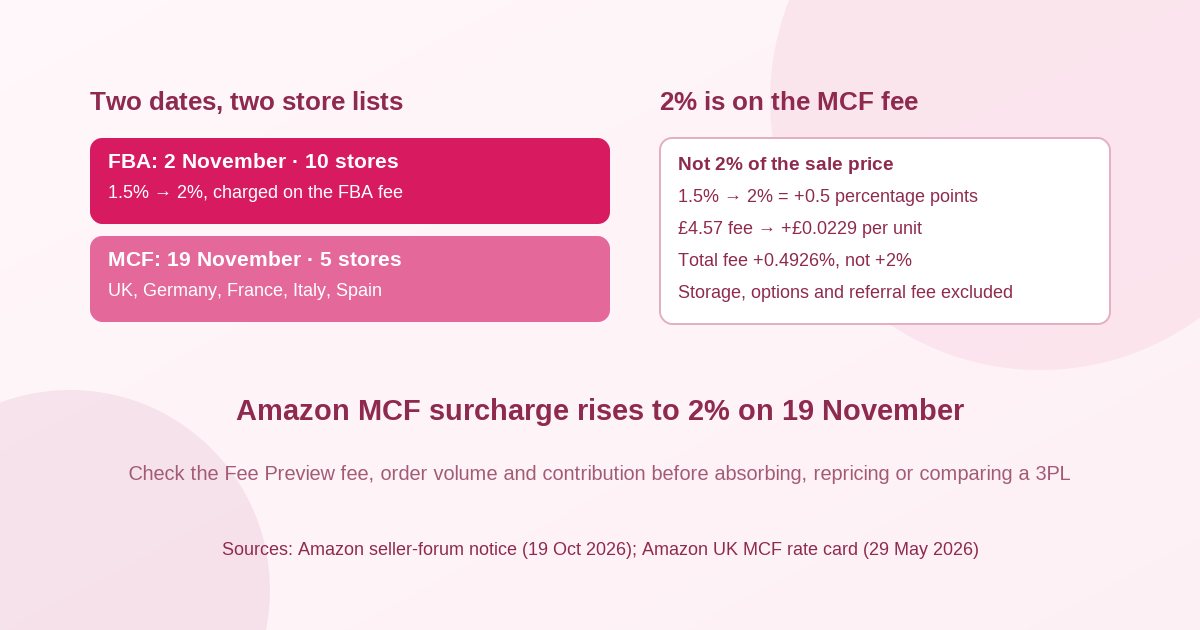
For sellers in the UK, Germany, France, Italy or Spain using Amazon Multi-Channel Fulfillment (MCF) for non-Amazon orders, the fuel and logistics-related surcharge on MCF fulfillment fees rose from 1.5% to 2% on 19 November 2026. This is not 2% of the sale price, and it is not a 2% increase in the whole logistics bill: the surcharge is charged on the MCF fulfillment fee, and the November step adds only 0.5 percentage points. For most orders the per-unit increase is a few pence to a few tens of pence. The real decisions are who absorbs this cost, whether it justifies changing the shipping charge, and whether a 3PL comparison should use the full MCF fee rather than this 0.5-point increment. Pull the actual fulfillment fee, order volume and per-order contribution from Fee Preview first; changing the fulfillment route on the headline '2%' alone is usually an overreaction.
1. What changed: FBA on 2 November, MCF on 19 November, ten stores versus five
In its seller-forum notice of 19 October 2026, Amazon says the fuel and logistics-related surcharge will rise from 1.5% to 2% on 2 November 2026 for FBA fulfillment fees in the UK, France, Germany, Italy, Spain, Poland, Sweden, the Netherlands, Ireland and Belgium. The same increase took effect for MCF fulfillment fees in the UK, France, Germany, Italy and Spain on 19 November 2026. The notice says the surcharge continues to be calculated on fulfillment fees, not on the sale price of the item; for EU FBA it averages about £0.02/€0.02 extra per unit, varying with size and dimensions. It gives no average MCF increment per unit. Amazon's earlier notice of 2 April 2026 introduced the 1.5% surcharge: FBA from 17 April 2026 and MCF from 2 May 2026, calculated on fulfillment fees, with an average of £0.05/€0.05 per unit for EU FBA; the 19 October notice raised the same surcharge to 2%.
Two boundaries are easy to misread. First, FBA and MCF have different effective dates: 2 November for FBA and 19 November for MCF. Applying the FBA date to MCF recalculates 17 days too early. Second, the store lists differ: ten stores for FBA, five for MCF. MCF in Poland, Sweden, the Netherlands, Ireland and Belgium is not in this 2% step; applying the ten-store list to MCF overstates the scope.
As of 29 November 2026, both effective dates in the notice have passed: FBA has carried 2% since 2 November and MCF since 19 November. This article has no seller's back-office bill and cannot verify that any individual account is being charged 2%. Check in this order: confirm the store and whether the service is FBA or MCF, then look for a change at the effective date in the surcharge line of Fee Preview, Profit Analytics or the settlement fee lines, and only then decide whether to adjust shipping or compare 3PLs. If the account does not yet show 2%, confirm the rate-card version and the covered stores with Seller Support instead of repricing on the notice alone.
| Service | Surcharge change | Effective date | Stores | Fee base |
|---|---|---|---|---|
| FBA | 1.5% → 2% | 2026-11-02 | UK, France, Germany, Italy, Spain, Poland, Sweden, Netherlands, Ireland, Belgium | FBA fulfillment fee |
| MCF | 1.5% → 2% | 2026-11-19 | UK, France, Germany, Italy, Spain | MCF fulfillment fee |
The notice names three places to check in Seller Central: Profit Analytics, the Revenue Calculator and the Fee and Economics Preview reports. They show the surcharge and the per-unit impact, but the actual settlement fee lines remain the final reference. The notice publishes no MCF rate table and no MCF average by size band, so Amazon's £0.02/€0.02 FBA average cannot be used as the MCF number.
2. What the 2% is charged on: three bases that are easy to confuse
The first base is the sale price. The surcharge is not 2% of the price. Take a UK standard-speed, single-unit small parcel of up to 400g with an MCF fulfillment fee of £4.57: the 2% surcharge is £0.0914, not £0.3998 on a £19.99 sale. Multiplying 2% by the sale price overstates the actual increment by about 17.5 times.
The second base is the whole logistics bill. The surcharge is charged only on the MCF fulfillment fee (pick, pack and ship); it is not charged on storage, optional services such as labelling, bagging or returns processing, or the referral fee. The rate card lists fulfillment, storage and optional services separately, and the reconciliation should keep them separate.
The third base is the 'increase'. Moving from 1.5% to 2% is an increase of 0.5 percentage points, not a 2% increase in the surcharge and certainly not a 2% increase in total fulfillment cost. Let F be the fulfillment fee: the old total is 1.015F and the new total is 1.02F, an increase of 0.005F, or about +0.4926% of the total. The surcharge line itself rises from 0.015F to 0.02F, a 33.3% increase. Both percentages are true, but they answer different questions: one is what the seller actually pays extra, the other is how the surcharge line changes.
| Basis | Formula | Example with F = £4.57 | What it means |
|---|---|---|---|
| Old surcharge | F × 1.5% | £0.0686 | The 1.5% MCF rate from May 2026 |
| New surcharge | F × 2% | £0.0914 | From 19 November 2026 |
| Surcharge increment | F × 0.5% | £0.0229 | What the seller actually pays extra |
| Old total | F × 1.015 | £4.6386 | Fulfillment fee plus surcharge |
| New total | F × 1.02 | £4.6614 | Fulfillment fee plus surcharge |
| Total increase | 0.005F ÷ 1.015F | +0.4926% | Not 2% |
The MCF fulfillment fee itself varies by size, weight, destination, delivery speed and number of units in the order. The same item sent to different countries, at standard or expedited speed, as a single unit or as three units, falls into different fee bands. The rate card gives public bands; the band that applies to a specific ASIN has to be checked in Fee Preview or the profitability reports.
Peak fees need a separate check. Amazon's peak-season notice of 14 July 2026 says a festive peak fulfillment fee applies to selected FBA orders in the UK and Germany from 15 October 2026 to 14 January 2027, and that the surcharge applies on top of the festive peak fee — the notice was published when the surcharge was 1.5%, and Amazon did not restate the stacking rate after the 19 October increase to 2%. The notice is about FBA; it does not apply the same peak rule to MCF. A seller using MCF should treat 'does a peak fee apply, and does the 2% stack?' as a separate check, not copy the FBA stacking rule onto MCF. VAT and taxes also need separate confirmation.
3. How to calculate the per-order increment: formula, real fee bands and sensitivity
The formula is simple: per-unit increment = MCF fulfillment fee F × 0.5%; for multi-unit orders, add F × 0.5% for each unit; monthly increment = monthly order volume Q × per-unit increment; annual increment = monthly increment × 12. As a share of the selling price, the increment is 0.5% × F ÷ P; as a share of per-order contribution, it is 0.5% × F ÷ C. C here is contribution after product cost, referral fee, fulfillment fee, advertising, returns and other variable costs, not net profit; fixed costs, labour and tax are separate.
| Size band (standard speed, 1 unit) | MCF fulfillment fee F | November increment (F × 0.5%) | New total (F × 1.02) |
|---|---|---|---|
| Light Envelope ≤100g | £3.43 | £0.0172 | £3.4986 |
| Small Parcel ≤400g | £4.57 | £0.0229 | £4.6614 |
| Standard Parcel ≤1.4kg | £6.40 | £0.0320 | £6.5280 |
| Small Oversize ≤760g | £10.75 | £0.0538 | £10.9650 |
| Heavy Oversize ≤31.5kg | £46.04 | £0.2302 | £46.9608 |
The table shows a counter-intuitive result: the absolute increment is driven mainly by F, not by the selling price. A £299 heavy item has an increment of about £0.23; a £19.99 small item has an increment of about £0.02. A higher price does not mean a proportionally higher surcharge; the increment is larger only when F is larger.
Sensitivity comes mainly from order volume and contribution. With F = £4.57, 1,000 orders a month produce £22.85, 5,000 produce £114.25 and 20,000 produce £457.00. At a contribution of £3.00 per order, the monthly increment is 0.76% of contribution at all three volumes; at £1.50, it is 1.52%. Volume scales the absolute amount; contribution scales the relative pressure. Keep the two separate.
| Monthly orders Q | Monthly increment (£4.57 × 0.5% × Q) | Share of contribution (C = £3.00) | Share of contribution (C = £1.50) |
|---|---|---|---|
| 1,000 | £22.85 | 0.76% | 1.52% |
| 5,000 | £114.25 | 0.76% | 1.52% |
| 20,000 | £457.00 | 0.76% | 1.52% |
For multi-unit orders, the second and third columns of the rate card give lower per-unit fulfillment fees; the surcharge is calculated on the fee that actually applies. Do not multiply the single-unit fee by the number of units, and do not apply the full single-unit fee after a multi-unit discount.
4. Two scenarios: high-volume small parcels versus low-volume heavy items
Both scenarios are hypothetical examples, not any real store's data. Scenario A uses the real UK Small Parcel ≤400g fee of £4.57; Scenario B uses the real Heavy Oversize ≤31.5kg fee of £46.04. The selling prices, order volumes, contribution and 3PL quotes are assumptions; replace them with your own data.
Scenario A: high-volume small parcels, shipping charged separately, only 0.5 points in November
Assume a UK seller shipping non-Amazon orders, one unit of up to 400g per order, standard speed, an MCF fulfillment fee of £4.57, a selling price of £19.99, a per-order contribution of £3.00 after product cost, referral fee, fulfillment fee, advertising and returns, 4,000 orders a month, and a separate shipping charge of £3.99 paid by the buyer. From 19 November, the per-order increment is £0.0229, the monthly increment is £91.40 and the annual increment is £1,096.80; that is 0.114% of monthly revenue of £79,960 and 0.762% of monthly contribution of £12,000. If contribution is only £1.50, the share rises to 1.523%.
This increment is not enough, on its own, to justify a 3PL switch. If the shipping charge can be adjusted, moving £3.99 to £4.02 is a 0.75% increase, usually a smaller risk than renegotiating a 3PL; if the charge cannot be adjusted or buyers are sensitive to shipping, absorb the increase as part of the fulfillment cost. Action: check in Fee Preview that the £4.57 band still applies and track the actual surcharge line monthly; if the increment exceeds 1% of monthly contribution for three consecutive months, revisit shipping or 3PL. Stop condition: if changing the shipping charge for this £0.02 causes a clear conversion drop, or the 3PL quote is less than £0.02 per order cheaper than MCF, it is not worth changing.
Scenario B: low-volume heavy items, shipping absorbed, price not updated since before April 2026
Assume a UK seller shipping Heavy Oversize items of up to 31.5kg, standard speed, an MCF fulfillment fee of £46.04, a selling price of £299, a per-order contribution of £15.00, 300 orders a month, shipping absorbed by the seller, and an MCF shipping price last set before April 2026 and not updated since. From 19 November, the full 2% surcharge is £0.9208 per unit, £276.24 a month and £3,314.88 a year; the November step alone adds £0.2302 per unit, or £69.06 a month. At £15.00 contribution per order, the full 2% equals 6.14% of monthly contribution of £4,500, while the November step equals 1.53%.
Assume a 3PL all-in quote of £44.00 per unit (pick, pack and ship, on a scope comparable with MCF); the new MCF total is £46.9608 per unit, an apparent saving of £2.9608 per unit, £888.24 a month and £10,658.88 a year. With a £2,000 switching cost, the static payback is about 2.25 months. If the 3PL quote is £46.00 per unit, the saving falls to £0.9608 per unit, £288.24 a month, and payback is about 6.94 months; at £47.50 per unit the 3PL is more expensive than MCF and should not be chosen.
Result: Scenario B justifies a 3PL comparison, but the reason is not the 0.5-point '2%' step; it is the gap between the full MCF cost and the 3PL all-in price. At £15.00 contribution per order, the £888.24 monthly saving equals 59.2 orders of contribution, or 19.7% of 300 orders. Action: test the heavy SKUs with a 30-day pilot and compare on-time delivery, damage, returns and customer-service tickets; if the 3PL causes more than about 19.7% order loss, the saving is offset by lost contribution. Stop condition: if the 3PL all-in price is above about £46.96 per unit, or on-time delivery falls below the MCF baseline or returns rise clearly during the test, keep MCF and include the 2% in the shipping price.
| Scenario | Key assumptions | Result | Action |
|---|---|---|---|
| A: high-volume small parcels | F = £4.57; P = £19.99; C = £3.00; Q = 4,000; shipping charged separately | Monthly increment £91.40; 0.76% of contribution | Absorb or add £0.03 to shipping; do not switch 3PL for this alone |
| B: low-volume heavy items | F = £46.04; P = £299; C = £15; Q = 300; shipping absorbed; price not updated | Full 2% £276.24 a month; November step £69.06; 3PL saves £888.24 a month | Compare 3PL all-in; pilot heavy SKUs; stop if order loss >19.7% |
The difference between the scenarios is not the '2%' itself but three variables: the size of F, the thickness of C, and whether the price already includes the 1.5% or 2% surcharge. Scenario A has a small F and thin C but high volume, so the absolute increase is small and the relative contribution impact is about 0.76%. Scenario B has a large F, a thicker C and low volume, so the full 2% is 6.14% of contribution while the November step is only 1.53%. Reducing both to '2% went up' misjudges A (overreaction) and B (underestimating the full exposure).
5. Evidence boundary and counter-cases: what the data cannot prove
Amazon's notice is the primary source for the dates, rate, stores and fee base, but it does not publish a per-ASIN MCF fee or an average MCF increment per unit. The £0.02/€0.02 figure is an EU FBA average and cannot be used as the MCF increment; sellers must use the actual F in Fee Preview or the profitability reports.
The UK MCF rate card is labelled 'As of 29 May 2026', but its PDF metadata shows a 20 November 2026 modification and its surcharge note already states 2%. It is useful for checking size bands, base fulfillment fees and the published surcharge wording, but it still does not prove that a particular seller's account has been charging 2% since 19 November; the actual settlement lines in Fee Preview are the reference. The rate card lists standard speed and 1, 2 and 3+ unit bands; destination, expedited speed, peak fees, storage, optional services and returns processing can all change the total. This article calculates only the surcharge on the fulfillment fee. Amazon's 14 July peak notice says the surcharge applies on top of the festive peak fee for selected FBA orders (the notice was written when the rate was 1.5%, and the 19 October notice did not restate the peak-fee rate), but does not state the same for MCF; this article does not apply the FBA stacking rule to MCF.
Counter-case one: a seller with few MCF orders and a high contribution per order may see a monthly increase of only a few pounds; switching 3PL for that alone may never repay the switching cost. Counter-case two: a seller with a high MCF fee and a clearly cheaper 3PL should switch, but the reason is the full fee gap, not the 0.5-point step; attributing the switch to '2%' would mislead the next decision. Counter-case three: a seller who can pass the full shipping charge to the buyer may recover the cost, but a higher shipping charge can reduce conversion; use an A/B test or historical elasticity and do not assume 'pass-through equals painless'.
Alternative explanation: a higher fee line may come from peak fulfillment fees, a size-tier reclassification, storage, optional services or returns processing, not this surcharge. Compare fee line by fee line; do not attribute every increase to the 2%.
6. Action checklist: fields to check, decision thresholds and stop conditions
Step one: pull the data. Export the last 90 days of MCF orders, group them by SKU × destination × delivery speed, and record the MCF fulfillment fee F, order volume Q, selling price P, per-order contribution C, who pays the shipping charge, and the date the price was last set. Without these fields, there is no way to tell whether 2% is 'a few pence' or 'several points of contribution'.
Step two: check the fee. Use Fee Preview, Profit Analytics or the Revenue Calculator to confirm each SKU's F and surcharge line, and confirm that MCF is charged at 2% from 19 November. Keep FBA and MCF separate, and keep fulfillment, storage and optional services separate.
Step three: calculate two numbers. One is the November increment: F × 0.5% × Q × 12. The other is the full 2% exposure: F × 2% × Q × 12, if the price has not been updated since before April 2026. They answer different questions: the first is this change, the second is the cumulative surcharge not yet recovered.
Step four: decide by threshold. The three thresholds below are examples, not industry standards; set them from your own contribution and cash flow. If the November increment is under 1% of monthly contribution, absorb it or make a small shipping adjustment; at 1%–3%, run a shipping A/B test for four weeks; above 3%, run a full 3PL comparison, using the all-in price, switching cost and service level, not just the surcharge.
| November increment / monthly contribution | Suggested action | Observation window | Stop or review condition |
|---|---|---|---|
| <1% | Absorb, or add the smallest shipping increment | 4 weeks | Revert if conversion falls |
| 1%–3% | Shipping A/B test; check 3PL all-in price | 4–6 weeks | Stop if the increment falls or 3PL service misses the baseline |
| >3% | Full 3PL comparison; pilot heavy SKUs first | 30-day pilot | Revert if order loss exceeds the break-even point |
Step five: set stop conditions. If the actual fee line does not match the model, fix the model before deciding. If a 3PL pilot lowers on-time delivery or raises damage or returns, stop expanding it. If a shipping change cuts conversion by more than the increment saved, revert it. Do not change shipping, switch 3PL and change packaging on the same SKU at the same time, or you will not know which variable did the work.
7. Limitations and uncertainties
This article has no seller's actual MCF bill, order mix, return rate or 3PL contract; every operating number is a hypothetical example. MCF fulfillment fees vary with size, weight, destination, speed, number of units and Amazon's rate changes; the rate card is the 29 May 2026 version and the seller's actual fee is the one in Seller Central.
The unknowns that could change the conclusion include the MCF share of orders, per-order contribution, the ability to pass shipping to buyers, buyer sensitivity to shipping, the 3PL's scope and service level, whether peak or other surcharges stack, and VAT and cross-border return costs. Update the judgment in this order: if Fee Preview shows an F clearly above or below the bands here, recalculate; if the 3PL all-in price is below about £46.96 per unit and service is acceptable, Scenario B can switch; if a shipping increase cuts conversion by more than it saves, Scenario A should return to absorbing. This article discusses public rates and hypothetical scenarios; it does not mean NWi provides MCF fulfillment-fee, back-office billing or settlement data. See the product data coverage and authorization boundary for the current scope. This article is not procurement, tax or legal advice.
8. What this analysis adds: turning '2%' into three decision variables
The increment here is not another repetition of 'Amazon raised a surcharge'; it separates the headline 2% into three testable variables: the rate change is 0.5 percentage points, not 2%; the base is the MCF fulfillment fee, not the sale price or the whole logistics bill; and the cumulative exposure depends on whether your price was last set before April 2026, between May and 18 November 2026, or on or after 19 November 2026. Once separated, a seller can tell whether the change is 'barely noticeable', 'worth a shipping adjustment' or 'worth a 3PL comparison'.
The division of labour with existing site content: the 2027 US FBA fee article covers the US, 2027 fulfillment and storage fees and the AWD/MCD surcharge; this article covers the November 2026 EU/UK MCF surcharge in five stores. The market, service, date and fee base are different, so the two cannot be applied to each other. The profit-calculation article provides the five-step subtraction from GMV to net profit; this article handles one surcharge inside the fulfillment-fee line and does not confuse revenue, gross margin or net profit.
Site links: for the Amazon analytics method, see Amazon analytics; for data definitions and citation guidance, see definitions and methods; for more reports, see the cross-border e-commerce reports center.
Sources
- 1. Amazon Seller Forums, "Update to FBA and MCF EU fuel and logistics-related surcharge" (primary, 19 October 2026): original, accessed 19 November 2026.
- 2. Amazon UK, "UK Multichannel Fulfillment fees" (primary, version as of 29 May 2026): original, accessed 19 November 2026.
- 3. Amazon, "Rate Card Europe Fees Effective as of 2 November 2026" (primary, effective 2 November 2026): original, accessed 19 November 2026.
- 4. Amazon Seller Forums, "Fuel and logistics-related surcharge: FBA and MCF in EU" (primary, 2 April 2026): original, accessed 19 November 2026.
- 5. Amazon Seller Forums, "Peak season 2026: Inventory dates, peak fees, deal cutoffs and promotions" (primary, 14 July 2026): original, accessed 19 November 2026.
Data basis: the FBA and MCF surcharge rates, effective dates, store lists and fee base come from Amazon's seller-forum notice of 19 October 2026; the 1.5% start dates come from Amazon's notice of 2 April 2026; UK MCF fee bands and surcharge wording come from Amazon UK's MCF rate card (labelled 'As of 29 May 2026'; PDF metadata shows a 20 November 2026 modification; the current text states 2%); the FBA rate card effective 2 November 2026 is used to check the FBA date and ten-store list; the festive peak fee and surcharge stacking rule for selected FBA orders in the UK and Germany from 15 October 2026 to 14 January 2027 comes from Amazon's peak-season notice of 14 July 2026. All selling prices, order volumes, per-order contribution, 3PL quotes and switching costs in the scenarios are explicitly labeled hypothetical examples, not any real store's data; amounts stay in their original currency and are not converted. Revised on 27 November 2026: a commercial Amazon seller-software source was removed; its statements on the 1.5% start dates, the five-store MCF scope and the fee base are all covered by Amazon's official notices of 2 April 2026 and 19 October 2026, and no rate, date or scenario figure changed. Rechecked on 29 November 2026: the notices of 19 October, 2 April and 14 July, the UK MCF rate card and the FBA rate card effective 2 November were read again; the article now records the post-effective stage of the five-store MCF 2% and the back-office check order, notes that the July peak notice's stacking rate was written at 1.5% and was not restated in October, corrects the earlier statement that the UK MCF rate card still showed 1.5% (the file is labelled 29 May 2026, its PDF metadata shows a 20 November 2026 modification and its text now states 2%), and corrects the £10.75 band's 0.5% increment from £0.0537 to £0.0538 on rounding; no other rate or scenario figure changed.
Revision note (27 November 2026): this article removes a commercial Amazon seller-software source and its reference entry. Its statements on the 1.5% start dates, the five-store MCF scope and the fee base are all covered by Amazon's official notices of 2 April 2026 and 19 October 2026. No rate, date, store list or scenario figure changed.
Revision note (29 November 2026): adds the current stage after the five-store MCF 2% took effect and the back-office check order; clarifies that the July peak notice's stacking rate was written when the surcharge was 1.5% and was not restated on 19 October; corrects the earlier statement that the UK MCF rate card still showed 1.5% (the file is labelled 29 May 2026, its PDF metadata shows a 20 November 2026 modification and its text now states 2%); corrects the £10.75 band's per-unit increment to £0.0538 on rounding; and replaces the generic disclosure with article-specific wording. Rates, dates, store lists and both scenario conclusions are unchanged.
This article was prepared with automated research assistance and was not reviewed by a human editor. Surcharge rates, effective dates, store lists and the fee base come from Amazon's seller-forum notices and the UK MCF and FBA rate cards; selling prices, order volumes, per-order contribution, 3PL quotes and switching costs are hypothetical examples, not any seller's actual bills or measured results. The article does not claim that Amazon has confirmed its billing conclusions and is not procurement, tax or legal advice.